10 June 2008

finally the campaign begins

After months, the Democrats have their candidate. One question remains: will feminists abandon the Democrats in November?  The fall election offers a test of the state of the Second Wave, whose disappointment over the decline of the inevitable Hillary Clinton presidency threatens to put McCain in her place. On substance, there is a wafer thin difference between Obama and Clinton (leaving aside her war vote). Their contest boiled down to differences in political style, melanin, and chromosomes. It is unnecessary to worry about those who oppose Obama based on his melanin advantage. It is more necessary to worry about those who may reject him based on gender.

*

Why Clinton? Why have older women and feminist organizations hitched their wagon of dreams to such a controversial figure? Clinton promised much, in particular a return to the good old 1990s when the economy boomed and the Yankees were world champions. However, she became a shape-shifter in the face of Obama's utopian wave. First, she was the most experienced candidate ('Ready on day one'). Later, she became the populist candidate of the single parent waitresses. In the end, she came out as a feminist candidate. Which Clinton is the real one? I would suspect the latter self-presentation is the truest. But it is fair to ask whether the difficulty she faced was not only sexism in the media but also her own personal history. Hillary Clinton is not just a woman candidate, she is a brand name. And her brand is not untarnished. Her front-runner status in January 2008 was based on name recognition. Once this shown to no longer suffice to move voters to her cause, the game was over. Her 'experience' advantage was not so overwhelming; hence, it didn't turn the tide against Obama. And her 'experience' in the area of policy in which she is most passionate, universal health care, was an abject failure. (Perhaps she thought this failure was erased from the memories of the Democratic electorate). Moreover, something else went without saying: Republicans would fight to the death to defeat such a policy proposed by a second President Clinton. Hillary Clinton's legacy in this area is much like her legacy as the first woman to crack the political glass ceiling: her defeat opened the door to more pragmatic choices. 

*

Political feminism should not be depressed over the dramatic fall of the inevitable one. Other less problematic women candidates exist and will emerge in time. Hillary Clinton was probably not the 'best chance' for putting a woman in the White House, although this particular nadir in Republican party prospects is a good chance for any breathing Democrat.


22 May 2008

will our media connect the dots between...

George Bush, before the Israeli Knesset:

Some seem to believe we should negotiate with terrorists and radicals, as if some ingenious argument will persuade them they have been wrong all along. We have heard this foolish delusion before. As Nazi tanks crossed into Poland in 1939, an American senator declared: 'Lord, if only I could have talked to Hitler, all of this might have been avoided.' We have an obligation to call this what it is -- the false comfort of appeasement, which has been repeatedly discredited by history.

and

Israel and Syria will begin indirect negotiations in Instanbul in a few weeks, in an effort to reach a peace agreement. (...) Prime Minister Ehud Olmert told Haaretz on Wednesday that 'there had been a development in Syrian positions and the contacts with Syria are a historic breakthrough.' Olmert added that 'these exchanges have been ongoing for a long time and they have now matured.'


20 May 2008

tempelhof

Tempelhof, my local neighborhood Flughafen during the Berlin year, is closing.


Oddly, its historical significance doesn't relate to my residence in the Tempelhof district but rather with the Luftbruecke of the late 1940s.


_________________________________
Photo credits: aerial view, Markus Schreiber /AP; interior views, Oliver Hartung New York Times.

20 March 2008

sin


The Church has added to the list of mortal sins:

Environmental pollution
Genetic manipulation
Accumulating excessive wealth
Inflicting poverty
Drug trafficking and consumption
Morally debatable experiments
Violation of fundamental rights of human nature

*

These seven new deadly sins will no doubt raise concern in the Catholic laity. But what is sin anyway? Here are a few selections from the Catechism of the Catholic Church.

1855  Mortal sin destroys charity in the heart of man by a grave violation of God's law; it turns man away from God, who is his ultimate end and his beatitude, by preferring an inferior good to him. Venial sin allows charity to subsist, even though it offends and wounds it.

1857 For sin to be mortal, three conditions must together be met: "Mortal sin is sin whose object is grave matter and which is also committed with full knowledge and deliberate consent."

1858 Grave matter is specific by the Ten Commandments, corresponding to the answer of Jesus to the rich young man: "Do not kill, Do not commit adultery, Do not steal, Do not bear false witness, Do not defraud, Honor your father and mother." The gravity of sins is more or less great: murder is graver than theft. One must also take into account who is wronged: violence against parents is in itself graver than violence against a stranger.

1859 Mortal sin requires full knowledge and complete consent. It presupposes knowledge of the sinful character of the act, of its opposition to God's law. It also implied a consent sufficiently deliberate to be a personal choice. Feigned ignorance and hardness of heart do not diminish, but rather increase, the voluntary character of a sin.

1860 Unintentional ignorance can diminish or even remove imputability of a grave offense. But no one is deemed to be ignorant of the principles of the moral law, which are written in the conscience of every man. The promptings of feelings and passions can also diminish the voluntary and free character of the offense, as can external pressures or pathological disorders. Sin committed through malice, by deliberate choice of evil, is the gravest.

1861 Mortal sin is a radical possibility of human freedom, as is love itself. It results in the loss of charity and the privation of sanctifying grace. If it is not redeemed by repentance and God's forgiveness, it causes exclusion from Christ's kingdom and the eternal death of hell, for our freedom has the power to make choices for ever, with no turning back. However, although we can judge that an act is in itself a grave offense, we must entrust the judgment of persons to the justice and mercy of God.

1033 We cannot be united with God unless we freely choose to love him. But we cannot love God if we sin gravely against him....Our Lord warns us that we shall be separated from him if we fail to meet the serious needs of the poor and the little ones who are his brethren. To die in mortal sin without repenting and accepting God's merciful love means remaining separated from him for ever by our own free choice. This state of definitive self-exclusion from communion with God and the blessed is called "hell."

*

It appears that these new mortal sins, if committed with full knowledge and complete consent and lacking repentance, will land the sinner in the hot place. Lesser sins can be purged by the fires of Purgatory.

1030 All who die in God's grace and friendship, but still imperfectly purified, are indeed assured of their eternal salvation; but after death they undergo purification, so as to achieve the holiness necessary to enter the joy of heaven.

1031 The Church gives the name Purgatory to this final purification of the elect, which is entirely different from the punishment of the damned. The Church formulated her doctrine of faith on Purgatory especially at the Councils of Florence and Trent. The tradition of the Church, be reference to certain texts of the Scripture, speaks of a cleansing fire.

Prior to the codification of this doctrine, various medieval writers weighed in on those sins which required purification in the fires of Purgatory. For example, an anonymous 7th century writer in Ireland specified that those who commit these "not very harmful" sins would be baptized by fire: "the idle use of legitimate marriage, overindulgence in eating, taking excessive pleasure in useless things, anger leading to abusive language, exaggerated interest in personal affairs, inattentiveness during prayers, late sleeping, undue bursts of laughter, overindulgence in sleep, holding back the truth, gossiping, sticking stubbornly to error, holding the false to be true in matters not involving faith, neglect of duty, and disorderly attire."*

*

In the spirit of this 7th century monk, I propose two more sinful acts that require purification.

The gratuitous appropriation of Arendt in lightweight scholarship
The use of the words experience or agency in polite company


_________________________________________________
* Jacques Le Goff, The Birth of Purgatory (Chicago: University of Chicago Press, 1984), 100.
art object credit: Hieronymus Bosch, The Seven Deadly Sins and the Four Last Things, 1485

19 March 2008

taming the exception


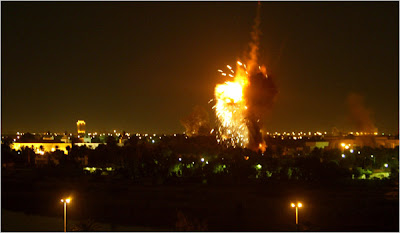
Today marks the fifth anniversary of the beginning of the Iraq war. America's fearless leader pronounced the removal of Saddam Hussein to be the "right decision." What began with significant public support is now an unpopular undertaking, the first big geopolitical blunder of the 21st century. The costs in Iraqi and American lives, wounded bodies, and money are well known. The political costs for the war seeking Republican party have been only partially registered. The big prize for the Conservative movement, the White House, is very much at risk. Further erosion of the Republican numbers in the Congress portend one of those tectonic shifts in the bedrock of governance, the size of which was last seen in 1980. Noble goals of advancing democracy and restoring human rights have been swamp by ignoble acts: fudged intelligence reports, bullying at the U. N., Democratic party expediency, political manipulation of the terror alert code, a willful pre-emptive war, the absence of weapons of mass destruction, Abu Ghraib, insurgency and civil war, torture, corruption, and generalized incompetence from the Pentagon, State Department, and White House. 

*


However, the Iraq war's actual beginnings go back to the first days after 9.11, during which emotion reigned over reason, the Congress handed the President a blank check to wage a war on terrorism, and even critical intellectuals went along for the ride. On 9.21.01 philosopher Michael Walzer published an Op-Ed in the New York Times which supported the use of the term "war":

So is it war? The word is unobjectionable as long as those who use it understand what a metaphor is. There is, right now, no enemy state, no obvious battlefield. "War" may well serve, however, as a metaphor to signify struggle, commitment, endurance. Military action, though it may come, is not the first thing we should be thinking about. Instead, in this "war" on terrorism three other things take precedence: intensive police work across national borders, an ideological campaign to engage all the arguments and excuses for terrorism and reject them, and a serious and sustained diplomatic effort.

Although the qualifying remark at the end of this passage is significant, it should not have been placed in a subordinate position with respect to the metaphor war.  When a conference was held in the days after this Op-Ed was published, Walzer appeared on stage with a political theorist who was in no mood for metaphorical speech: "If it looks like a war and smells like a war, it is a war." Later in the fall of 2001, the cream of the post-New Left critical intelligentsia assembled in New York to assess the situation; all but one used the term "we" to describe the relationship between "us" (the West, the United States) and "them" (terrorists, middle easterners). This "consensus" was that "our" values and political institutions should be defended. The slippage from metaphor to reality came easily. But beyond these best and brightest critical intellectuals, the State does not know metaphor, it knows only concrete action. War doesn't signify anything to a State. War is the use of force.

*

What was required at the time was skepticism towards the use of the word war. Reasons for suspecting the inadequacy of this definition arise when its discursive and practical limits are explored. In order to examine these limits, one must first ask what kind of action is entailed by defining an act of war. Rather than treating this action as self-evident, as a natural or necessary consequence of the events of 9.11, it should be viewed as a world-constituting action that sets the context for specific practical interventions. The declaration of an act of war is a meaning making event. The logic and consequences of this discursive move requires interrogation because the definition of the situation sets limits on future permissible and impermissible actions, both domestically and internationally.

Because of its clear Hobbesian overtones, Carl Schmitt's Political Theology* is a useful tool for bringing clarity to the discursive implications of being-at-war (metaphorical or otherwise). Of direct relevance to the events of 9.11 is his concept of the "exception" and its relation to sovereignty and actions that suspend the rule of law.

Sovereign is he who decides the exception (...). The assertion that the exception is truly appropriate for the juristic definition of sovereignty has systematic, legal-logical foundation. The decision on the exception is a decision in the true sense of the word. Because a general norm, as represented by an ordinary legal prescription, can never encompass as total exception, the decision that a real exception exists cannot therefore be entirely derived from this norm (...). The exception, which is not codified in the existing legal order, can at best be characterized as a case of extreme peril, a danger to the existence of the state, or the like. But it cannot be circumscribed factually and made to conform to a preformed law. (pp. 5-6)

What Schmitt imagines is a scenario in which sovereignty comes into sharp focus, such as when the State (a single or collective actor) takes an action that transcends the existing legal order. Such an exceptional action, which Schmitt associates with a situation of extreme political or economic peril, abjures the rule of law even if the decision on the exception is premised on the presence of legal norms. The decision corresponds to events that cannot be entirely planned for within the normatively and normally valid legal system. In short, the occurrence of the unexpected calls forth, and can only be addressed by, the decision on the exception: the sovereign. Schmitt intends his discussion as a presentation of a "general concept in the theory of the state, and not merely to a construct applied to any emergency decree and state of siege." (p. 5) His larger point is to ground the legal order on sovereignty rather than a norm: "After all, every legal order, which is applied as something self-evident, contains within it the contrast or two distinct elements of the juristic -- norm and decision. Like every other order, the legal order rests on a decision and not on a norm." (p. 10) Schmitt's decisionism is not the concern here; rather, I am only interested in the insight that his concept of sovereignty provides on the decision that defines an act of war (being-in-war and being-at-war).

In this formulation, Schmitt affirms that it is the sovereign who possesses unlimited power. He points out that the tendency of the liberal constitutional state is to "repress the question of sovereignty by a division and mutual control of competences." Such a tendency is evidenced by the system of checks and balances provided for in the American Constitution, of which the enactment of the War Powers Act of 1973 is a prime example. Yet, according to Schmitt, no amount on constitutional maneuvering can remove the defining moment of sovereignty: the act of deciding the exception. Although Schmitt does provide insight into the ontological conditions of the political, his account of this relationship cannot be accepted at face value. What he defines as an ontological difference (sovereignty versus the nor) is a very practical one. What is missing in Schmitt's otherwise crystalline account of sovereign power is a logically prior step on the way to the decision. This step involves the definition of a state of affairs as anomalous enough to warrant a decision on the exception. The representation of a state of affairs as a state of emergency is the discursive precondition of the enactment of sovereignty. Nonetheless, a state of emergency is itself not self-evident. From an ontological perspective, it might be construed as a state of existence which is outside the norm; a rupture in the fabric of everyday life by something unexpected. From a practical perspective, however, the definition of this break with everyday life is the irruption of the political: the "break" is an act of political definition. This act constitutes a world or space of experience, authorizes certain relations of authority within this experience (sovereignty), which then override other relations of authority (the rule of law).

*

In the days before the war began, Jean Baudrillard** described the imminent war as a nonevent.

The analysis must start with this will of cancellation, obliteration, and laundering of the original event [9.11], which makes this war ghostly, to some extent unimaginable since it does not have a final purpose, a necessity, or even of a true enemy (Saddam is only a puppet). This war merely has the form of a conspiracy, of an event that is precisely impossible to do away with. The result is that it is already perpetual, before even having been started. In fact, it has already taken place, and the suspense itself is part of this masquerade. It opens towards and endless war that will never take place. And it is this suspense that awaits us in the future, this diffuse topicality of blackmail and terror in the form of a universal principle of prevention.

This "mask of war", a war foreshadowed by the declaration of a state of emergency, extends the invocation of sovereignty around the world.

This global situation gives credence to Virilio when he speaks about a planetary civil war. The most dramatic political consequence of these events is the collapse of any concept of international community and, more generally, of any system of representation and legitimacy. And the recent world mass demonstrations against the war where, one believes, a rising countervailing power is emerging, are themselves only a worrying symptom of his hiatus, of this fracture of representation. Nobody wants the war, and yet it will take place no matter what, with the more or less camouflaged approval of all powers.

*

The exception, unleashed by Bush's decision, has not been entirely tamed. But events such as the failures to legitimate the state of emergency and the overwhelming inadequacy of the sovereign have reduce the scope of the exception. In the end, only regime change can bring the norm back, but will even that be enough?

____________________________________________
*Carl Schmitt, Political Theology: Four Chapters on the Concept of Sovereignty (Cambridge, M.A.: MIT Press, 1985 [1934]).
**Jean Baudrillard, "The mask of war," Liberation, 3.10.03
photo credit: bomb exploding in  Baghdad 3.19.03, Tyler Hicks @ New York Times
photo credit: Butterfly by Ascona, 3.22.03

18 March 2008

infantile raciality


Barack Obama has delivered the great race speech of 2008. One pundit (Sally Quinn) declared on MSNBC that Obama's speech was the most important contribution to racial dialogue since M. L. King Jr.'s "I have a dream" speech of 1963. Obama, as usual, did weave together personal narrative with political and social dilemmas, and sounded the community organizer's call for Oneness in the face of a more powerful Other: corporations, lobbyists, terrorists, and the disembodied threat of ecological catastrophe. The most striking element, however, was his effort to work through the psychological issue of anger on both sides of the racial divide. More Oprah than Dr. Phil, Obama situates himself as a vessel of, and agent for, racial healing; as an exemplary person for extraordinary times. The religious (in the Durkheimian sense) dimension of Obama's candidacy is no less palpable than the materialist (in the Marxist sense) opposition that arises from the Clinton campaign. The choice is clear: the mission of national renewal versus the fight for redistributive policies within a recessionary capitalist market.

*

The boldest implication of Obama's speech is that his candidacy offers the possibility of mass psychoanalysis, a therapeutic treatment for America's infantile raciality. The ressentiment of the dispossessed, referencing concrete hurts and frustrations, seeks out -- in an animistic style of thought -- invisible forces in the social world which are perceived to be the source of dispossession. Race is just such a force, a malevolent god or spirit that works to thwart (or facilitate) the pleasure of specific groups, that is, the satisfaction of needs that are both physical and emotional: material wealth and social recognition (i.e., status honour). To race is attributed an amazing capacity of creation of groups, motives and consequences of action; success and failure is legitimated or disqualified by this idea. This is no less a miracle than the transubstantiation accomplished during the Catholic communion: blessed wine and wafers become the blood and body of Christ; different degrees of melanin function as a cosmological explanation of reality, the invisible yet visible hand shaping individual fate. What Obama suggests is no less radical than the Copernican turn in Western science: geocentrism and raciocentrism can be replaced through a shift in perspective. However, like ressentiment for the Father's disposession of the son's unmediated access to the Mother, it is not easy to give up racial anger; hence, sexual development and social development is "arrested" or, more properly stated, fixated in an anal stage, an infantile stage. Pain and anger become substitutes for the lost Mother or forestalled social achievements, they become the object-cathexis of the resentful child and the resentful adult. It is as if the child-adult or adult-child says you've taken away what I should have by right, so this is all I have left, my anger, my suffering, and I won't let that be taken away. This anger is mine and you can't have it! 

*

Whether a public official can facilitate this working through of past pain is uncertain (Mandela comes to mind as one such person whose success in this area -- in South Africa -- remains uncertain). The cause remains noble even if a tragic mode of emplotment seems the likely outcome of the story. This is the risky path Obama has chosen, however: to stand for a missionary purpose while needing to engage in mundane worldly activities. Obama's candidacy stands as a sort of test of Durkheim and Weber: are the sacred and profane radically opposed (Durkheim) or can an affinity exist between other-worldly (in the sense of transcendent) goals and this-worldly intensive activity. 

____________________________________________
art object credit: The Great Chain of Being from Rhetorica Christiana by Didacus Valades, 1579

13 March 2008

vice


Why is sex for money between consenting adults a criminal act? Allegedly, this is not a "victimless crime", given the demographic background of women involved (no mention of male prostitution is made). The arguments for criminalization are that women are victimized whether they consent or not, sex trafficking is a growth industry, health risks increase for prostitutes, and other forms of illegality circle around prostitution. Experiments in legalization apparently have had mixed results. What seems to work best in combating prostitution, according to Nicholas Kristof, is the arrest and prosecution of customers.

*

But these policy concerns beg the question of why sex is dangerous when it is bartered, so that its sale must be proscribed, hemmed in, driven underground, and turned into a stigma. The only sufficient answer comes from Freud, who argues that civilization only exists to the extent that sexual instincts, both constructive and destructive, are repressed, sublimated, rendered socially useful. Hence, Freud's narrative of the primal horde, the monopolization of pleasure by the Father, the original patricide, and the subsequent denial of access to women among the bloody band of brothers. But the Father who enjoys pleasure (le pere jouissance) also denies pleasure to Others (ala Zizek/Lacan), and this denial rather than enjoyment becomes the hallmark of civilization and created the conditions of possibility for psychoanalysis: the generation of an unconscious as the psychical vessel of the repressed, the creation of moral rules that are opposed to human needs, and the subsequent neurotic afflictions that arise under the pressure of morality.

*

The tale of the primal horde is a myth of origins (of civilization). Freud's textual account of this myth, in Totem and Taboo, is mythological (or mythopoetic/mythopsychoanalytic): it functions as a screen memory for a hypothetically real event that is, in reality, a necessary fantasy. It is "necessary" as a historical point of departure for that which is ahistorical (the Unconscious; the general, structural Unconscious which is not to be confused with the particular unconscious). The elements of Freud's myth/fantasy/dream memory are comprised of the objects that interact in the formation of the Superego (in the male child at least). Freud takes what occurs in the unconscious past of each individual and places it in the unconscious past of civilization, the infantile stage of human society. The original denied object of pleasure, the mother, is transformed into a taboo on all familiar women. Why is this necessary? Because sex is analytically linked to power (to the Father); it is dangerous to possess (for the one whose monopoly on sex led to his demise), impossible to hold (for the brothers, who are confronted by an ever renewed war of all against all), and better kept under control (for the individual, who must submit to the Father anyway). On this account, sex is never between individuals, it is between subjects of social and psychical compulsion. Fear of pleasure, which I will conjecture owes significantly to the rise of monotheism, makes all sex dangerous; the adding of monetary value to it doubles the pleasure and the danger.

_______________________________________
art object credit: Anthony Frederick Augustus Sandys, Mary Magdalene, 1860